Abstract
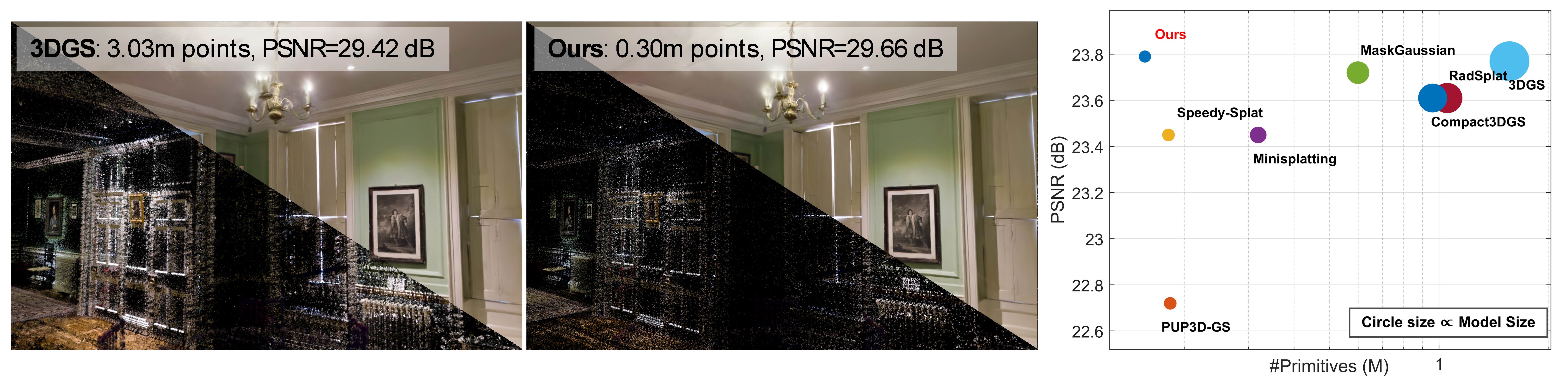
Recent significant advances in 3D scene representation have been driven by 3D Gaussian Splatting (3DGS), which has enabled real-time rendering with photorealistic quality. 3DGS often requires a large number of primitives to achieve high fidelity, leading to redundant representations and high resource consumption, thereby limiting its scalability for complex or large-scale scenes. Consequently, effective pruning strategies and more expressive primitives that can reduce redundancy while preserving visual quality are crucial for practical deployment. We propose an efficient, integrated reconstruction-aware pruning strategy that adaptively determines pruning timing and refining intervals based on reconstruction quality, thus reducing model size while enhancing rendering quality. Moreover, we introduce a 3D Difference-of-Gaussians primitive that jointly models both positive and negative densities in a single primitive, improving the expressiveness of Gaussians under compact configurations. Our method significantly improves model compactness, achieving up to 90\% reduction in Gaussian-count while delivering visual quality that is similar to, or in some cases better than, that produced by state-of-the-art methods.
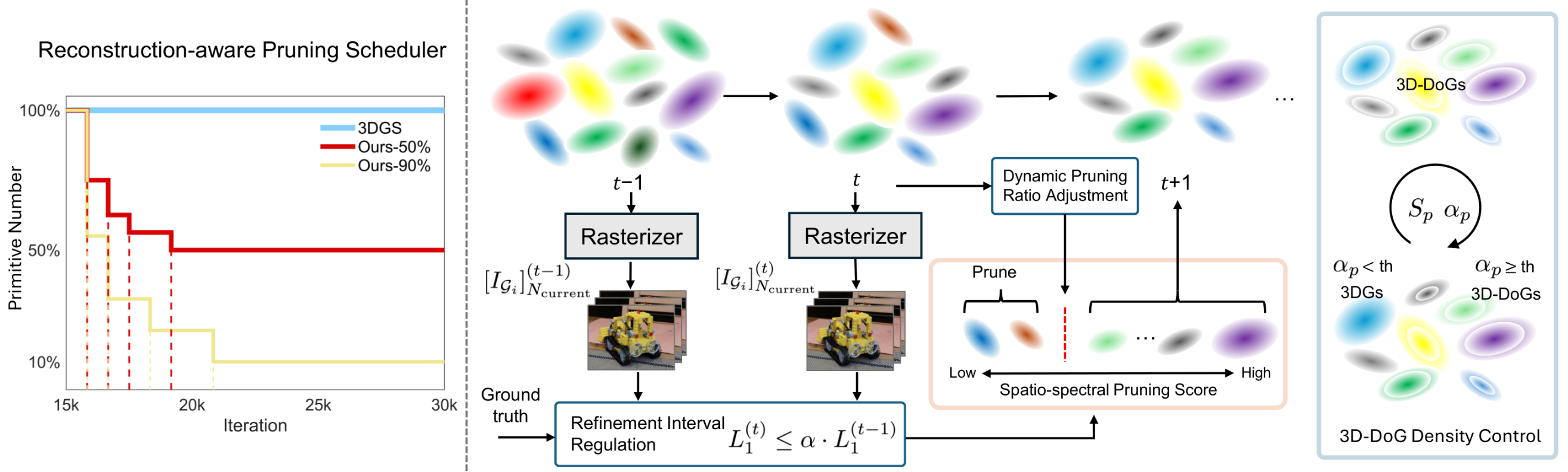
(Left) Gaussian primitive count comparison. Our method adaptively adjusts the refinement settings to meet different pruning targets, such as the 50% and 90% pruning ratios shown in the figure. (Right) Overview of the Reconstruction-aware Pruning Scheduler and 3D-DoG Density Control. We use L1 loss as a reconstruction quality indicator to dynamically determine pruning timing and ratio throughout optimization. In addition, we activate 3D-DoG after pruning and adaptively control its density.
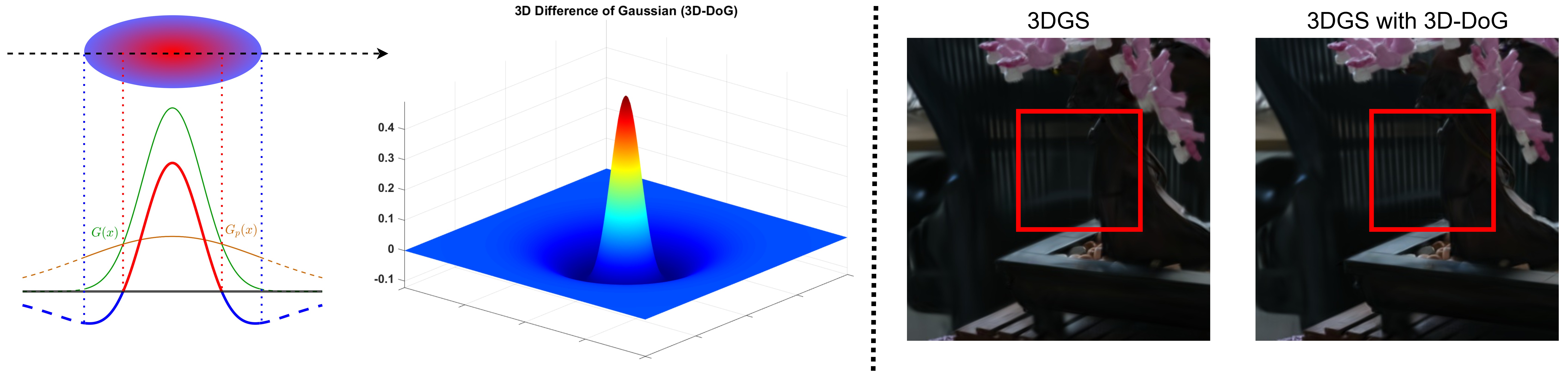
Illustration of the proposed 3D-DoG primitive in 1D and 3D, featuring a positive-density peak and a negative-density ring. 3DGS with 3D-DoG primitives achieves better detail representation.
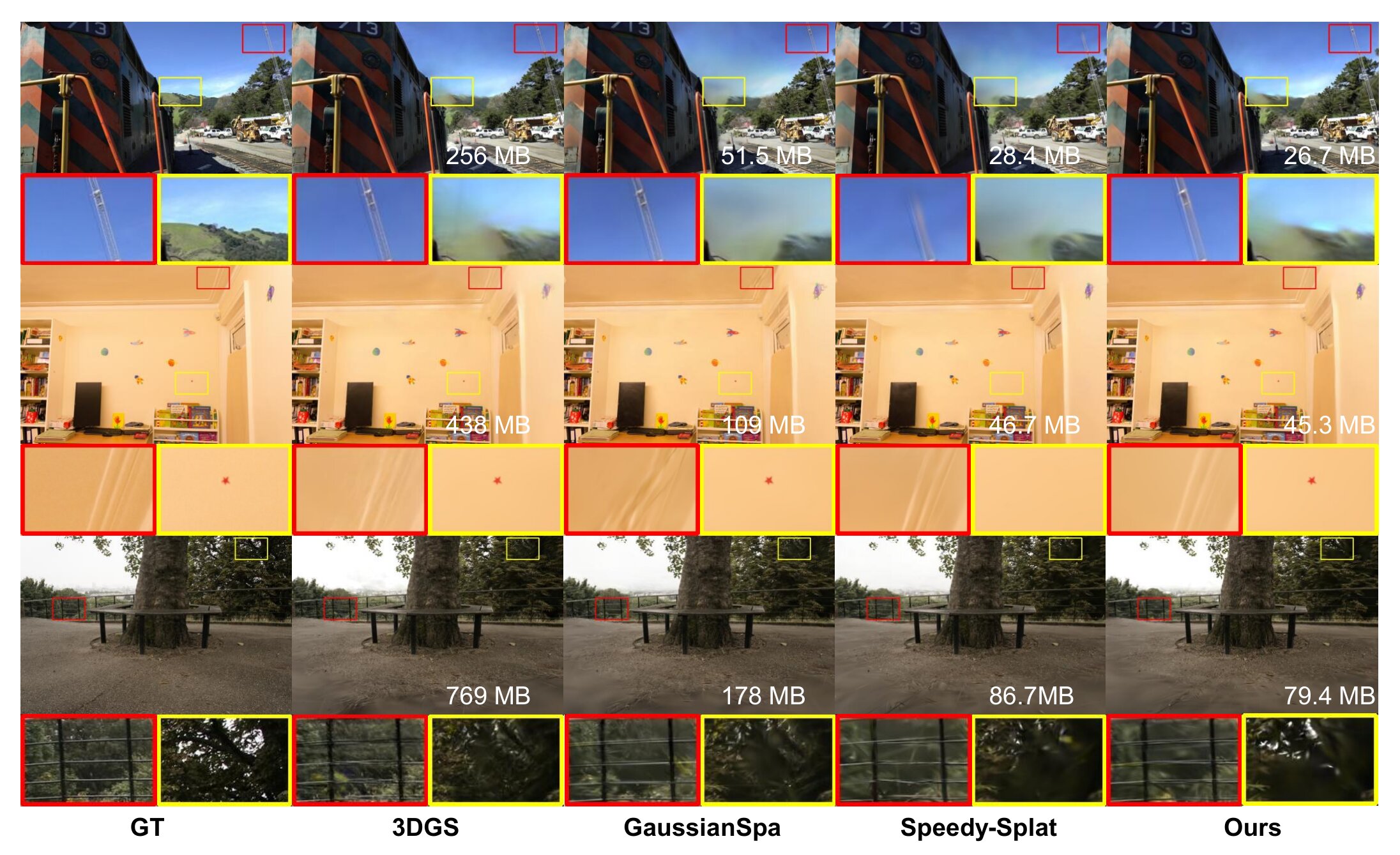
Novel view rendering comparison with the baselines. Top: Train from the Tanks & Temples. Middle: Playroom from the Deep Blending dataset. Bottom: Treehill from the Mip-NeRF 360 dataset. We have shown details below the images.
BibTeX
@inproceedings{wang2026prune,
  title={Prune Wisely, Reconstruct Sharply: Compact 3D Gaussian Splatting via Adaptive Pruning and Difference-of-Gaussian Primitives},
  author={Wang, Haoran and Huang, Guoxi and Zhang, Fan and Bull, David and Anantrasirichai, Nantheera},
  booktitle={Proceedings of the IEEE/CVF Conference on Computer Vision and Pattern Recognition},
  pages={11716--11725},
  year={2026}
}